

Albuquerque Anchor & Building Safety
Albuquerque is New Mexico's largest city and its commercial center, with a building stock that ranges from the 22-story towers of downtown to the medical campuses along the UNM corridor, the office parks of Uptown and Journal Center, and a fast-growing multifamily sector on the Westside and along I-25. Hospitals, hotels, university facilities, and government buildings all rely on rooftop anchor systems so that window cleaners, facade crews, and maintenance technicians can work safely at height.
ADS Contractors provides annual anchor inspection, load testing and recertification, and complete compliance documentation for Albuquerque property managers and building owners. Every anchor on the roof is inspected, photographed, and tested. Nothing is sampled, and the report you receive is the record your building needs when a contractor asks for proof before tying off.
Many of Albuquerque's mid-rise and high-rise buildings date from the 1960s through the 1980s, and a large share of their original anchor and davit systems have never been formally certified. Newer construction from the last decade is now reaching its first 10-year recertification window. In both cases, the question is the same: is there a current, engineer-backed record on file for every anchor on the roof?
High Desert Sun and Hard Seasons
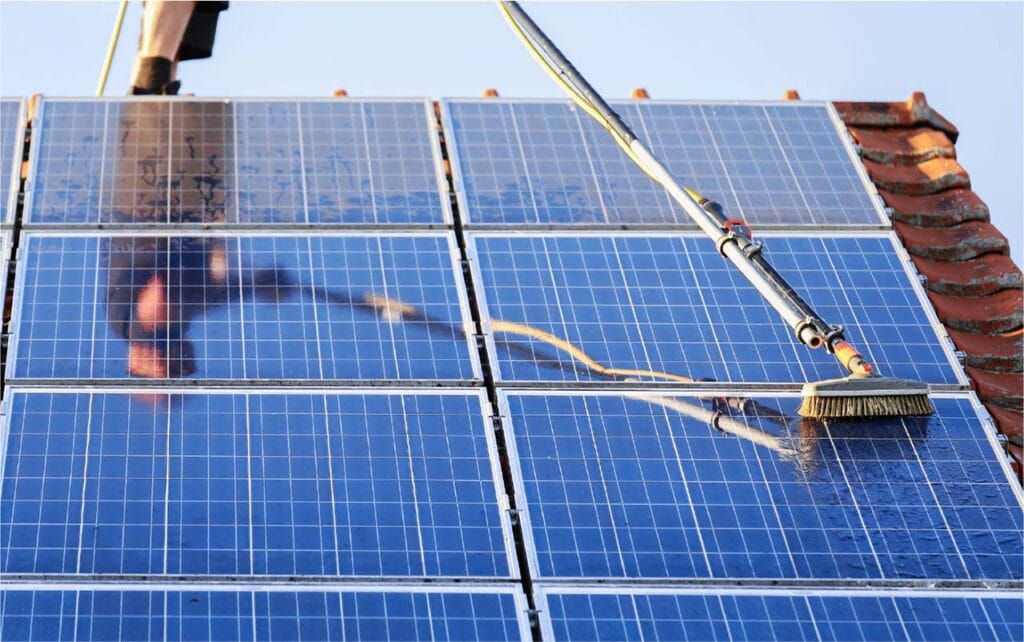
Albuquerque sits between roughly 5,000 and 6,000 feet of elevation with more than 280 days of sun a year. Thinner air at that altitude means stronger ultraviolet exposure than almost any other major Western city, and UV is what breaks down the sealant at roof penetrations, fades the identification labels that inspectors and contractors rely on, and chalks protective coatings on anchor posts and base plates.
The daily temperature swing routinely exceeds 30 degrees, and winter brings weeks of freezing nights followed by sunny afternoon thaws. That constant expansion and contraction works fasteners loose and opens hairline gaps where water can reach the structure below the anchor. The July to September monsoon then drives heavy rain and lightning through those gaps, and spring winds gusting past 50 miles per hour load every exposed davit arm and post with dust-laden air.
None of this damage is visible from the roof hatch. It shows up as corrosion under a base plate, a cracked weld, or a post that moves under load, which is why a visual walk-through is not a substitute for a documented inspection of each anchor.
Albuquerque Areas We Serve
We serve properties throughout the Albuquerque metro and the Rio Grande corridor:
Downtown
Uptown
UNM and Medical Corridor
Nob Hill
Journal Center
North I-25 Corridor
Westside
Rio Rancho
Mesa del Sol
Santa Fe
ADS Contractors schedules New Mexico work in dedicated trips. Grouping several buildings, or a whole portfolio, onto one visit lowers the cost per building, and we coordinate timing with your window cleaning or facade contractor so the roof is certified before their crews arrive.
What New Mexico Requires of Building Owners
New Mexico operates its own OSHA-approved state plan through the Environment Department's Occupational Health and Safety Bureau, and that plan enforces the federal walking-working surfaces rules for rope descent systems. Under OSHA 1910.27(b)(1), before any contractor uses a rope descent system on your building, the owner must inform the contractor in writing that each anchorage has been identified, tested, certified, and maintained so it can support at least 5,000 pounds in any direction for each worker attached to it.
That written statement has to rest on an annual inspection by a qualified person and a certification of each anchorage at least every 10 years. Buildings with powered platforms or davit systems also fall under OSHA 1910.66, and the industry standards that inspectors work to, ANSI/IWCA I-14.1 for window cleaning and ANSI Z359 for fall protection equipment, set out how the inspection and testing are performed and documented.
In practice this means three things for an Albuquerque owner or manager. Every anchor needs a current annual inspection record with photographs. Every anchor needs a certification, backed by load testing and a licensed engineer's review, that is less than 10 years old. And those records need to be on file and ready to hand to the next contractor who asks. Missing any one of them stalls window cleaning and facade projects, shifts liability onto the building, and complicates an insurance claim if something goes wrong.
ADS Contractors delivers all three as one package: the inspection, the load test of every anchor, and the engineering certification, along with a building-specific report and an anchor plan your contractors can work from. Read more in our Roof Anchor Compliance Guide.
Albuquerque Roof Anchor Frequently Asked Questions
Does New Mexico require roof anchor inspections?
Yes. New Mexico enforces the federal OSHA rope descent rules through its state plan. OSHA 1910.27(b)(1) requires the building owner to have each anchorage inspected annually by a qualified person and certified at least every 10 years, and to confirm that in writing to any contractor before a rope descent system is used on the building.
How often do anchors in Albuquerque need load testing?
Certification, which includes load testing, is required at least every 10 years. ADS Contractors tests every anchor on the roof rather than a sample. Anchors should also be re-evaluated after anything that could have affected them, such as a re-roof, a hailstorm, a nearby lightning strike, or structural work on the roof deck.
What problems does the high desert climate cause for anchor systems?
Intense UV degrades sealant and labels, daily temperature swings loosen hardware and open gaps at roof penetrations, and monsoon rain finds its way into those gaps. The most common findings on Albuquerque roofs are corrosion under base plates where sealant has failed, missing or unreadable anchor labels, and loose fasteners. All three are inexpensive to correct when caught at an annual inspection.
My building has no anchor records at all. Where do I start?
Start with an inspection and load test. ADS Contractors documents every anchor, tests each one, and works with a licensed engineer to produce a certification you can put on file. If anchors fail or the roof has none, we design and coordinate the retrofit. Contact us with the building address and we will tell you what records are needed and what the visit involves.
Ready to Get Started?
Contact ADS Contractors today for a free evaluation. We will assess your building's anchor and davit systems and provide a detailed report with no obligation.
Contact Us Today