

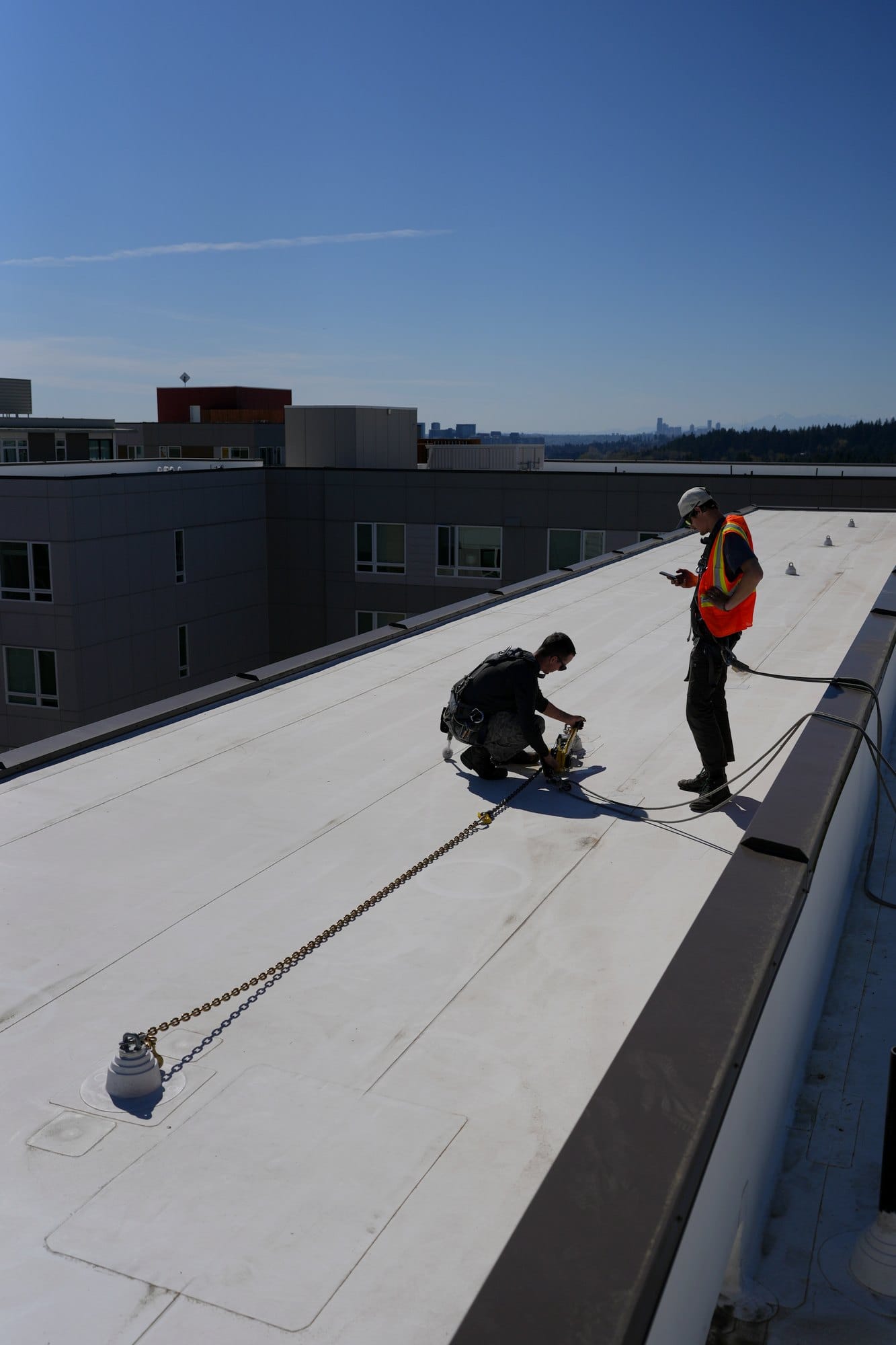
What Hydraulic Proof Load Testing Verifies
Load testing is the only way to prove what a roof anchor can actually hold. A visual inspection tells you what an anchor looks like. A proof load test tells you whether the anchor will perform under the pull a worker would create in a fall.
For commercial fall protection anchors in Seattle, the standard is 5,000 pounds in any direction the anchor could be loaded. The number comes from OSHA 1910.27(b)(1) and ANSI Z359.18. A proper proof load test applies hydraulic force to the anchor in the appropriate vector, holds the load for the specified duration, and documents whether the anchor passes or fails.
The test is non-destructive when the anchor passes. It is destructive in the sense that an anchor failing the test should never be used again. That is the point of testing. Better to find the deficient anchor on a planned test day than during an actual rescue.
When Load Testing Is Required
Load testing is required in several specific situations in Seattle:
- 10-year recertification. Every full engineering recertification includes proof load testing of every anchor in the system. This is when most testing happens.
- After repair or replacement. Any anchor that has been repaired, retrofitted, or replaced must be load tested before returning to service.
- After known impact or building modification. Roof work, structural retrofits, or any damage to the anchor or surrounding substrate requires re-testing the affected anchors.
- When original documentation cannot be found. If a building has anchors but no installation records or capacity documentation, load testing is the only way to establish the system's safe working load.
- 5-year cycle for buildings under ANSI/IWCA I-14.1. Some buildings are managed under the ANSI/IWCA I-14.1 5-year load testing cycle in addition to the OSHA 10-year recertification cycle.
Owners who add load testing to their annual inspection cycle catch problems earlier and avoid being surprised at the 10-year recertification.
The 5,000 Pound Standard and How We Reach It Safely
The 5,000 pound capacity requirement comes from the worst-case load a falling worker can generate. To prove an anchor can hold that load, we apply the test load in a controlled, instrumented way using a calibrated hydraulic test rig.
Our Staht hydraulic test units pull each anchor in the same direction a worker would load it, with continuous load monitoring and a digital record of the pull curve. The test holds at the certified load for the standard duration. If the anchor moves, displaces, or shows substrate failure under the load, the test fails and the anchor is documented as out of service.
Fall restraint anchors, which are designed only to keep workers back from the edge rather than catch a fall, are not tested under this protocol. They are evaluated through visual inspection and substrate review instead.
Test Scope and Selection
ADS load tests every anchor on the roof as standard practice, so certification rests on measured results for the whole system. For very large portfolios, sampling programs are available on request, with the sampling plan set by the licensed structural engineer signing off on the recertification based on:
- Total number of anchors on the building.
- Number of distinct anchor types and substrates present.
- Age of the system and the condition observed during visual inspection.
- Whether the original engineering documentation is available.
- The use case (fall arrest, rope descent, suspended access).
When a sampling program is used, samples are chosen to cover every anchor type, every substrate, and the highest-risk locations on the roof, and any anchor that fails triggers expanded testing of similar anchors elsewhere on the building. The standard approach stays simple: every anchor gets tested.
Seattle Roof Anchor Load Testing FAQ
What is roof anchor load testing?
It is a hydraulic proof load test that applies a controlled pull to a roof anchor and confirms whether it can hold the required capacity, which is 5,000 pounds in any direction for commercial fall protection anchors in Seattle. The test uses calibrated equipment with continuous load monitoring and produces a digital record of the pull.
How much does each anchor get loaded?
Anchors are typically tested to the certified capacity of 5,000 pounds, held for the specified duration set by the applicable standard. The test load is applied in the direction the anchor would experience under actual use. The exact protocol depends on the anchor type, the standard governing the work, and the engineer of record.
Does every anchor on the roof need to be tested?
As standard practice, yes. ADS load tests every anchor on the roof. Sampling programs are available on request for large portfolios; in that case the licensed structural engineer signing the certification approves the sampling plan, and any failed anchor triggers additional testing of similar anchors.
How long does load testing take?
On a typical Seattle building, load testing for a recertification takes one to three field days, depending on the number of anchors, roof access, and weather. We coordinate with property management to minimize disruption to building operations.
What happens if an anchor fails the load test?
The anchor is immediately taken out of service and documented in the field record. The engineer issuing the recertification reviews the failure and recommends a repair, replacement, or retrofit path. The remaining anchors that passed continue to be available for use during the repair process.
Are fall restraint anchors load tested too?
Generally no. Fall restraint anchors, designed only to keep a worker back from the edge rather than catch a fall, carry a lower design capacity and are not tested under the same protocol as fall arrest anchors. They are evaluated through visual inspection and substrate review.
Our Seattle Anchor Services
Annual Anchor Inspection
Yearly visual and structural inspection with photographic documentation.
10-Year Recertification
Stamped engineering review for rope descent system anchors hitting the federal 10-year deadline.
Tie Back Recertification
Engineering certification for rope descent and suspended access tie backs.
Hydraulic Load Testing
Instrumented load testing with documented hold times and a pass or fail record for each anchor tested.
Davit Arm Inspection
Articulating davit arm inspection for high-rise window washing systems.
All Seattle Services
Return to the Seattle service hub for an overview of every offering.
Ready to Get Started?
Contact ADS today for a free evaluation. We will assess your building's fall protection systems and provide a detailed report with no obligation. Call us at (206) 338-2584.
Contact Us Today