

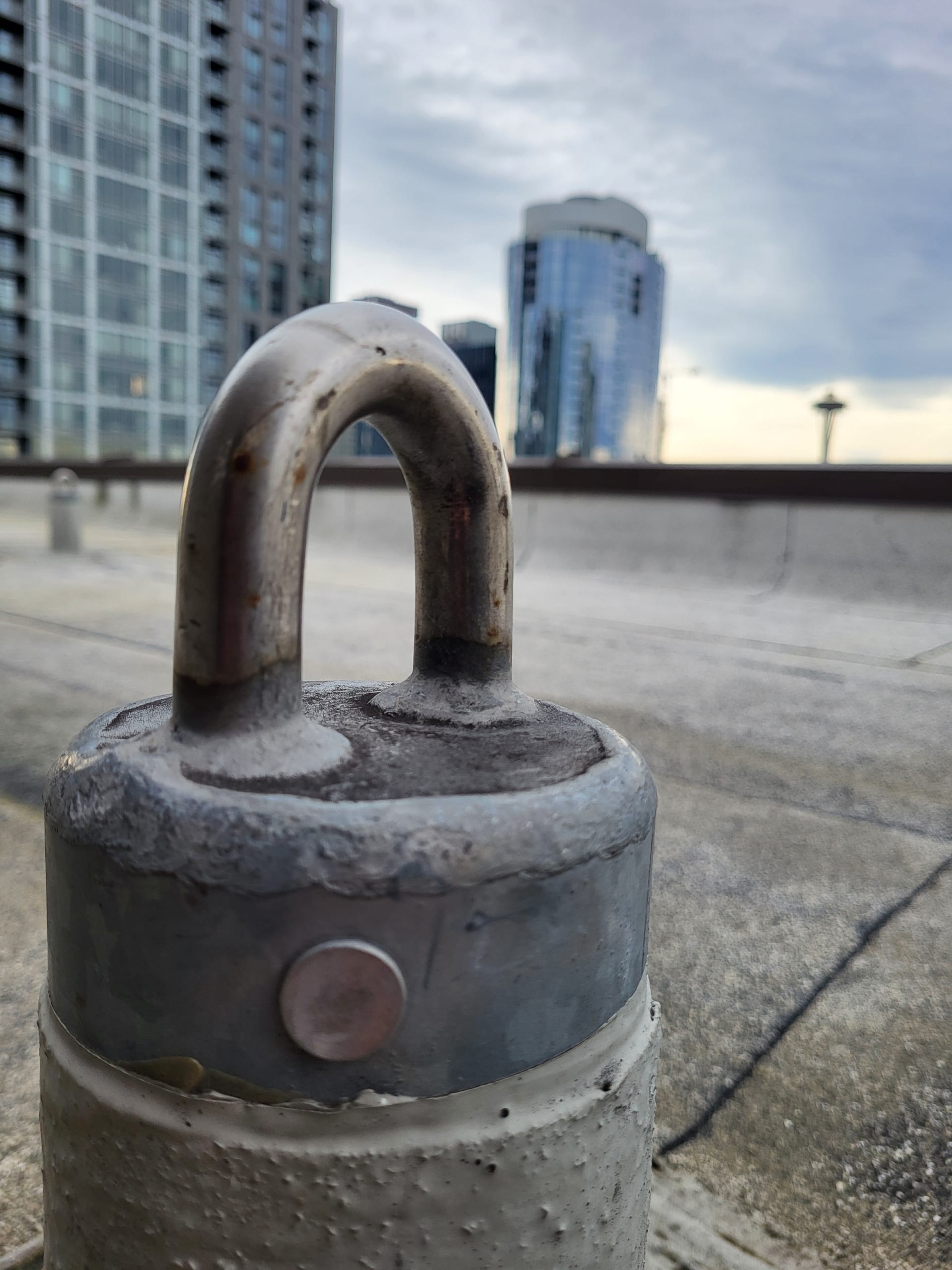
What a Tie Back Anchor Actually Does
A tie back anchor is the rooftop attachment point that secures a suspended worker on the side of a building. Window cleaners, facade inspectors, caulkers, and any rope descent technician working below the roof line clips into a tie back before going over the edge. If anything fails between the worker and the building, the tie back is what keeps the worker alive.
Tie backs are distinct from the general fall arrest anchors used by roofers walking the surface. They are designed for the specific load case of a worker hanging from a rope on the side of a high-rise, sometimes for hours at a time. Their certification, inspection, and recertification follow the rules in OSHA 29 CFR 1910.27(b)(1), the rope descent system standard.
If your Seattle building has window washing scheduled, has a rope descent technician working the facade, or has any contractor using suspended access below the roof line, the tie backs they connect to must be certified.
The OSHA 1910.27(b)(1) Rule That Drives This Work
The federal rope descent system standard, enforceable since 2017, puts the certification burden directly on the building owner. The rule requires:
- Written certification, signed by a qualified person, that each anchor on the building is capable of supporting at least 5,000 pounds in any direction.
- An inspection by a qualified person at least once every 12 months.
- A full engineering recertification at least every 10 years.
- Recertification or evaluation after any structural change, repair, or known impact to the anchor.
The rule applies the moment a rope descent technician arrives at the building. There is no exemption for smaller buildings, no exemption for residential, and no exemption for buildings that have never had a problem.
In Washington state the federal rule is enforced by the Department of Labor and Industries under WAC 296-880. L and I issued more than $1.4 million in fall protection fines in the fourth quarter of 2025 alone.
Why Seattle's 2014 to 2018 Buildings Are All Coming Due
Seattle added thousands of mid-rise and high-rise buildings between 2014 and 2018. Almost all of them were equipped with tie back anchor systems for window washing and rope access. Those anchors were certified when the building was built, and that certification was good for 10 years.
The math is simple. Buildings finished in 2014 are due for their first recertification in 2024. Buildings finished in 2015 are due in 2025. Buildings finished in 2016 are due in 2026. The wave is hitting right now. Most Seattle owners with mid-2010s buildings either have not done it yet or do not realize the original certification has expired.
If your building has any tie back anchors, was completed between 2014 and 2018, and does not have a recent recertification letter on file, the building is overdue. The first sign for most owners is a window washing contractor asking to see the documentation before scheduling the work.
The Tie Back Recertification Process
For Seattle tie back recertification specifically, our process covers:
- Tie back location verification. We confirm every tie back anchor on the roof, including any concealed or hidden anchors, and add them to a labeled roof plan.
- Hardware and connection inspection. Each tie back is inspected for corrosion, fatigue, weld integrity, and proper installation against the manufacturer's specifications.
- Hydraulic proof load testing of every tie back, verifying capacity to the 5,000 pound OSHA standard. ADS tests every tie back as standard practice; sampling programs are available on request for large portfolios.
- Substrate evaluation. The structural connection point, whether concrete, steel, or another substrate, is evaluated against original design loads.
- Engineering review by a licensed structural engineer, who issues a stamped recertification letter valid for 10 years.
For a longer walkthrough of why mid-2010s Seattle buildings are at the center of this wave, see our tie back recertification guide for the 2014 to 2018 building boom.
Seattle Tie Back Recertification FAQ
What is a tie back anchor?
A tie back anchor is a permanent rooftop attachment point used by suspended workers, primarily window cleaners and facade technicians, who work below the roof line on ropes. The tie back is what keeps a suspended worker connected to the building. It is required and regulated under OSHA 29 CFR 1910.27(b)(1).
How is a tie back different from a fall arrest anchor?
A fall arrest anchor is designed for a worker walking on a surface who might fall. A tie back is designed for a worker who is deliberately suspended below the roof line on a rope, often for hours at a time. They are designed for different load cases. The OSHA rule that governs tie backs is OSHA 1910.27(b)(1), the rope descent system standard.
What is OSHA 29 CFR 1910.27(b)(1)?
It is the federal rule, enforceable since 2017, that requires building owners to provide written certification that each anchor on the building can hold at least 5,000 pounds. It applies to any rope descent system used on the building. The certification must be based on annual inspection and 10-year engineering recertification.
Does every building with window washers need tie back certification?
Yes, if the window washers use rope descent, which is the standard method for most mid-rise and high-rise buildings in Seattle. Buildings using only scaffolding and lifts may not require tie back certification, but the moment any contractor anchors a rope to the roof, the certification requirement applies.
What if I don't know where my tie backs are?
This is common with older buildings and with buildings that have changed ownership. Tie back location verification is the first step of the recertification process. We locate every tie back on the roof, including any that are hidden, painted over, or otherwise difficult to find, and add each one to a labeled roof plan.
Are tie backs the same as davit arms?
No. A tie back is a fixed anchor point that a worker clips into directly. A davit arm is an articulating mast that holds a suspended platform or chair out away from the building. Both are forms of fall protection equipment but they are inspected and certified separately. ADS offers davit arm inspection as a separate service.
Our Seattle Anchor Services
Annual Anchor Inspection
Yearly visual and structural inspection with photographic documentation.
10-Year Recertification
Stamped engineering review for rope descent system anchors hitting the federal 10-year deadline.
Tie Back Recertification
Engineering certification for rope descent and suspended access tie backs.
Hydraulic Load Testing
Instrumented load testing with documented hold times and a pass or fail record for each anchor tested.
Davit Arm Inspection
Articulating davit arm inspection for high-rise window washing systems.
All Seattle Services
Return to the Seattle service hub for an overview of every offering.
Ready to Get Started?
Contact ADS today for a free evaluation. We will assess your building's fall protection systems and provide a detailed report with no obligation. Call us at (206) 338-2584.
Contact Us Today