

What a Hydraulic Test Proves That Eyes Cannot
A roof anchor can look perfect and still be compromised where it counts: in the load path below the base plate. Denver weather is specifically good at creating that condition. Freeze-thaw cycles work fasteners and embeds loose a fraction of a millimeter at a time. Hail cracks the sealant that keeps water out of the penetration, and once moisture is inside, corrosion advances under the flashing where no visual inspection can follow. High-altitude UV embrittles the sealants years ahead of schedule, and a winter of snow sitting against the base keeps the whole detail wet.
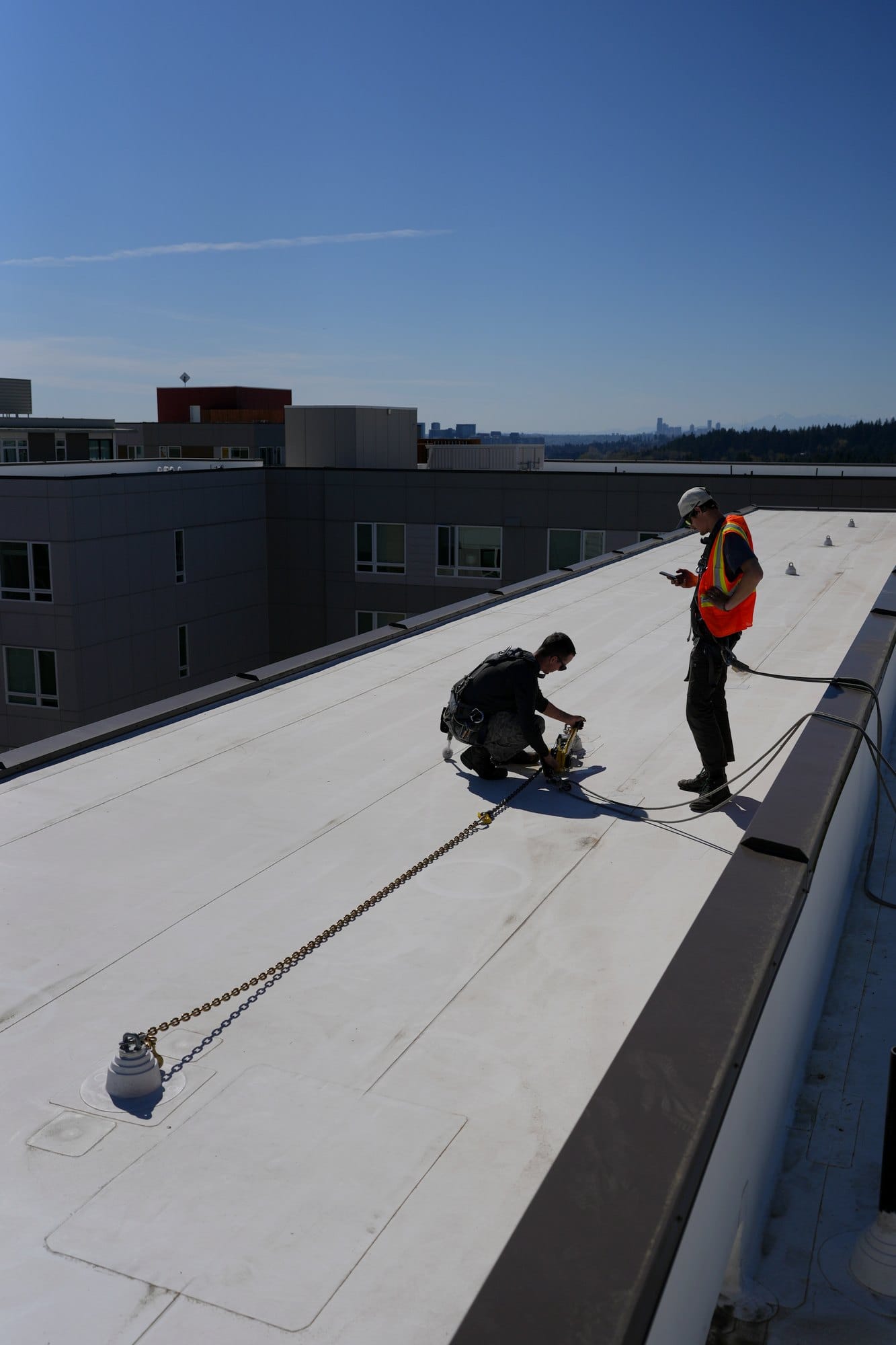
Hydraulic load testing answers the question a visual check cannot: does this anchorage still carry load the way it did the day it was installed? A calibrated ram applies a controlled pull, the anchor either holds for the documented time or it does not, and the result is recorded for that specific anchor on that specific date.
ADS Contractors brings its documentation-driven testing process to Denver buildings, with each test logged against a numbered roof plan. See the Denver services hub for how testing fits into the wider compliance calendar.
The Capacity Standard Behind the Test
For rope descent anchorages, the benchmark comes from OSHA 29 CFR 1910.27(b)(1): the building owner must identify, test, certify, and maintain each RDS anchorage so it is capable of supporting at least 5,000 pounds per attached worker, with written certification, annual inspection, and recertification at least every 10 years. The rule says "test" in so many words, which is why testing is the backbone of any defensible certification file.
The field test itself is run to the levels specified by the anchor manufacturer and applicable standards, with documented hold times, because test loads and rated capacities are not the same number and a careless pull can damage a healthy anchor. What lands in your report is a pass or fail for each tested anchorage, the parameters used, and photographs of the setup.
Because Colorado has no state occupational safety plan, the federal standard governs Denver buildings directly; the OSHA state plans page lists which states differ. And with HB 26-1054 pending in the legislature, a bill Colorado Newsline reports would embed those federal standards in state law with penalties up to $70,000 for willful violations, the value of a documented test record in Colorado is headed up, not down. Details on the statewide picture live on our Colorado page.
When a Denver Building Needs Load Testing
- No records, unknown installer. The building traded hands and the anchor file did not survive the sale. Testing rebuilds proof of capacity from scratch.
- Supporting the 10-year renewal. Test results are the field evidence inside a roof anchor recertification, the package a licensed structural engineer reviews before stamping the letter. The national recertification page shows where testing sits in that sequence.
- After a violent hail season or rooftop construction. Impact and trade traffic are the two most common ways a Denver anchor gets damaged between inspections.
- A failed or inconclusive visual. When the annual inspection flags movement, corrosion staining, or substrate cracking, a test settles the question with data instead of judgment.
- A vendor asked for documents that do not exist. Suspended work cannot lawfully proceed without owner certification, and testing is usually the fastest route to a document that holds up.
If several of these apply at once, it is usually cheaper to fold testing into a full recertification than to buy it twice.
Which Anchors Get Tested, and Which Do Not
Not everything bolted to a Denver roof should meet a hydraulic ram. Rope descent anchorages carry the federal testing and certification duty described above. Fall arrest anchors, the points workers clip into while moving across the roof, are tested when the manufacturer's instructions call for it or when their history is unknown.
Fall restraint anchors are the exception owners should understand. A restraint anchor's job is to keep a worker from reaching the edge at all, and its published 1,000 pound figure is a design capacity assigned by the manufacturer, not a field test target. Restraint anchors are verified through inspection against the manufacturer's criteria. A testing vendor who quotes you a hydraulic pull on restraint anchors is selling you something the standards do not ask for.
Sorting your roof into those categories is part of the scoping conversation, and it is covered in plain language in our roof anchor compliance guide and, with Denver specifics, in the Denver building owner's guide to roof anchor inspections.
Denver Roof Anchor Load Testing FAQ
Do all of my roof anchors need load testing?
No. Rope descent anchorages carry the federal testing and certification duty, and fall arrest anchors are tested per the manufacturer's instructions or when records are missing. Fall restraint anchors are design-rated by the manufacturer and verified through inspection, not hydraulic pulls. Scoping starts by sorting the roof into those categories.
Will the test damage my roof or the anchor?
A properly run test does not. Loads are applied with a calibrated ram to the levels the anchor manufacturer and applicable standards specify, held for a documented time, and released in a controlled way. Rig staging is padded to protect the membrane, and the penetration detail is checked after the pull. An anchor that fails under those parameters was already unsafe to use.
Should anchors be retested after a big hailstorm?
After a damaging Front Range hail event, have the anchor penetrations and sealant inspected along with the roof. Testing is warranted when the inspection finds cracked bases, opened joints, water staining, or any sign the load path took damage. Hail claims season is also a practical moment to fix anchor details while the roofer is already mobilized.
Is a load test the same as recertification?
No. The test is field verification of capacity. Recertification wraps that evidence together with the inventory, condition inspection, and a licensed structural engineer's review into the stamped 10-year letter that OSHA 29 CFR 1910.27(b)(1) expects owners to hold. Test results feed the letter; they do not replace it.
Our Denver Anchor Services
Annual Anchor Inspection
Yearly competent person inspection with photos and a numbered roof plan.
10-Year Recertification
Stamped engineering recertification for anchorages reaching the federal deadline.
Tie Back Recertification
Certification for the rope descent tie backs suspended workers rig from.
Hydraulic Load Testing
Hydraulic pull testing with documented hold times, pass or fail recorded.
Davit Arm Inspection
Arm, base, and socket inspection for suspended access davit systems.
All Denver Services
Visit the Denver hub for an overview of every service in the metro.
Ready to Get Started?
Contact ADS Contractors for a free evaluation of your building's roof anchor systems. We will review your documentation, scope the work, and provide a clear quote with no obligation.
Contact Us Today