

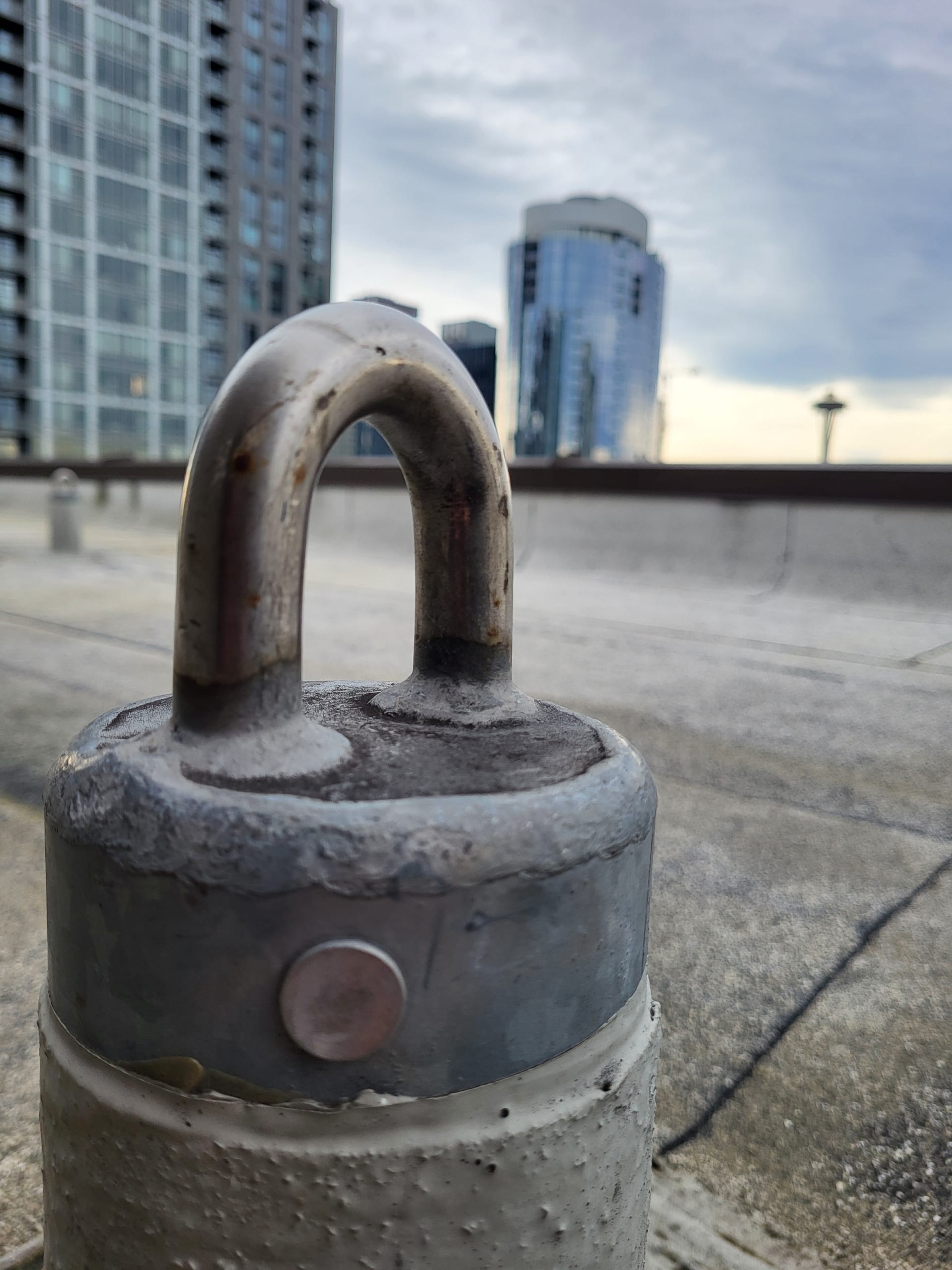
The Document Your Facade Vendor Will Not Work Without
The request usually arrives a week or two before scheduled facade work: the vendor asks for the building's tie back certification, and if the letter on file is expired or missing, the job stops before it starts. Their technicians cannot lawfully tie off to your roof until you, the owner, provide written certification for the anchorages. That is not the vendor being difficult. It is how the federal rule allocates the duty.
Tie backs are the fixed anchor points that rope descent workers, window cleaners, caulkers, and facade inspectors connect to before going over the parapet. They live outdoors full time, they are the last line between a suspended worker and the street, and in Denver they take a beating: freeze-thaw cycles working at their bases, hail opening their sealant joints, snow holding moisture against the penetration, and high-altitude UV aging every exposed material faster than the spec sheet assumed.
Recertification is how a decade of that weather gets formally accounted for, and it is one of five anchor services on our Denver hub.
The Federal Rule, With No Colorado Buffer
OSHA 29 CFR 1910.27(b)(1) is the rope descent system rule, and it is written to the building owner: identify, test, certify, and maintain each RDS anchorage so it can support at least 5,000 pounds per attached worker, keep written certification on file, have the anchorages inspected annually, and recertify at least every 10 years or after anything that could affect capacity.
Colorado never stood up its own occupational safety agency for private employers, a status you can verify on the federal OSHA state plans list, so that rule reaches Denver rooftops directly. There is no local variance to hide behind, and the pending HB 26-1054, described in Colorado Newsline's coverage, would go the other way entirely: locking federal standards into state statute and adding Colorado enforcement with penalties up to $70,000 for willful violations. It is a bill, not a law, and its details may shift. Its direction will not.
For the full statewide regime, see the Colorado overview page.
RiNo and Union Station Towers Are Entering the Window
Denver's mid-2010s development run, the towers around Union Station, through LoDo, and into RiNo, produced a concentrated cohort of buildings whose tie backs were installed and first certified between roughly 2014 and 2017. On the federal 10-year cycle, those certifications expire between 2024 and 2027. This is not a future problem; the first waves are already due.
Two Denver-specific complications make the cohort messier than the calendar suggests. First, many of these buildings have been sold at least once, and original anchor documentation regularly fails to make the closing binder. Second, when owners here go looking for help, the search results are dominated by out-of-region firms with a Denver landing page and no particular interest in a mid-rise with fourteen tie backs. Owners deserve a specialist that treats this as the whole job, not a sideline.
ADS Contractors brings its documentation-driven certification process to Denver buildings of exactly that profile, from boutique mid-rises to full-block towers.
What Tie Back Recertification Involves
- Locate and map. Each tie back is found, numbered, and placed on a roof plan, including anchors that are concealed, painted over, or absent from the drawings.
- Inspect. Hardware, welds, fasteners, corrosion, and the substrate connection are checked against the manufacturer's installation requirements, with the Denver weather damage patterns above in mind.
- Test. Anchorages are load tested to the levels specified by the anchor manufacturer and applicable standards, with documented hold times and a recorded result per anchor.
- Certify. A licensed structural engineer reviews the field data and issues the stamped recertification letter that satisfies 1910.27(b)(1) for the next decade.
If your building is also due on its general anchor system, the roof anchor recertification page covers the full-roof version of this process, and buildings with platform rigging should add a davit inspection so every part of the suspended load path is documented together. The national recertification service page and our roof anchor compliance guide explain the methodology behind the stamp, and the Denver building owner's guide adds the local context.
Denver Tie Back Recertification FAQ
What exactly is a tie back anchor?
A tie back is a permanent rooftop anchor point that suspended workers connect their ropes and lifelines to before descending the face of the building. It is engineered for the load case of a person hanging below the roof line, which is why it carries its own certification regime under OSHA 29 CFR 1910.27(b)(1) rather than the general fall protection rules.
When is my Denver building due for tie back recertification?
Ten years from the last certification letter. For the Union Station, LoDo, and RiNo buildings finished between 2014 and 2017, that means due dates between 2024 and 2027. A building with no findable certification letter should be treated as due immediately, because an expired or missing letter has the same practical effect: suspended work cannot proceed.
What paperwork satisfies my window washing vendor?
A current written certification for each rope descent anchorage, stamped by a licensed structural engineer, plus the most recent annual inspection report. Send both before the job is scheduled and the crew chief's checklist is a formality. Without them, the vendor's own safety program obliges them to decline the work, however long they have serviced the building.
What if the original certification cannot be found?
Recertification rebuilds the record from the roof up: inventory, inspection, testing, and a new stamped letter. Prior paperwork speeds the records review but is not required. This is one of the most common Denver scenarios we see, particularly on buildings that have traded since the mid-2010s construction cycle.
Our Denver Anchor Services
Annual Anchor Inspection
Yearly competent person inspection with photos and a numbered roof plan.
10-Year Recertification
Stamped engineering recertification for anchorages reaching the federal deadline.
Tie Back Recertification
Certification for the rope descent tie backs suspended workers rig from.
Hydraulic Load Testing
Hydraulic pull testing with documented hold times, pass or fail recorded.
Davit Arm Inspection
Arm, base, and socket inspection for suspended access davit systems.
All Denver Services
Visit the Denver hub for an overview of every service in the metro.
Ready to Get Started?
Contact ADS Contractors for a free evaluation of your building's roof anchor systems. We will review your documentation, scope the work, and provide a clear quote with no obligation.
Contact Us Today