

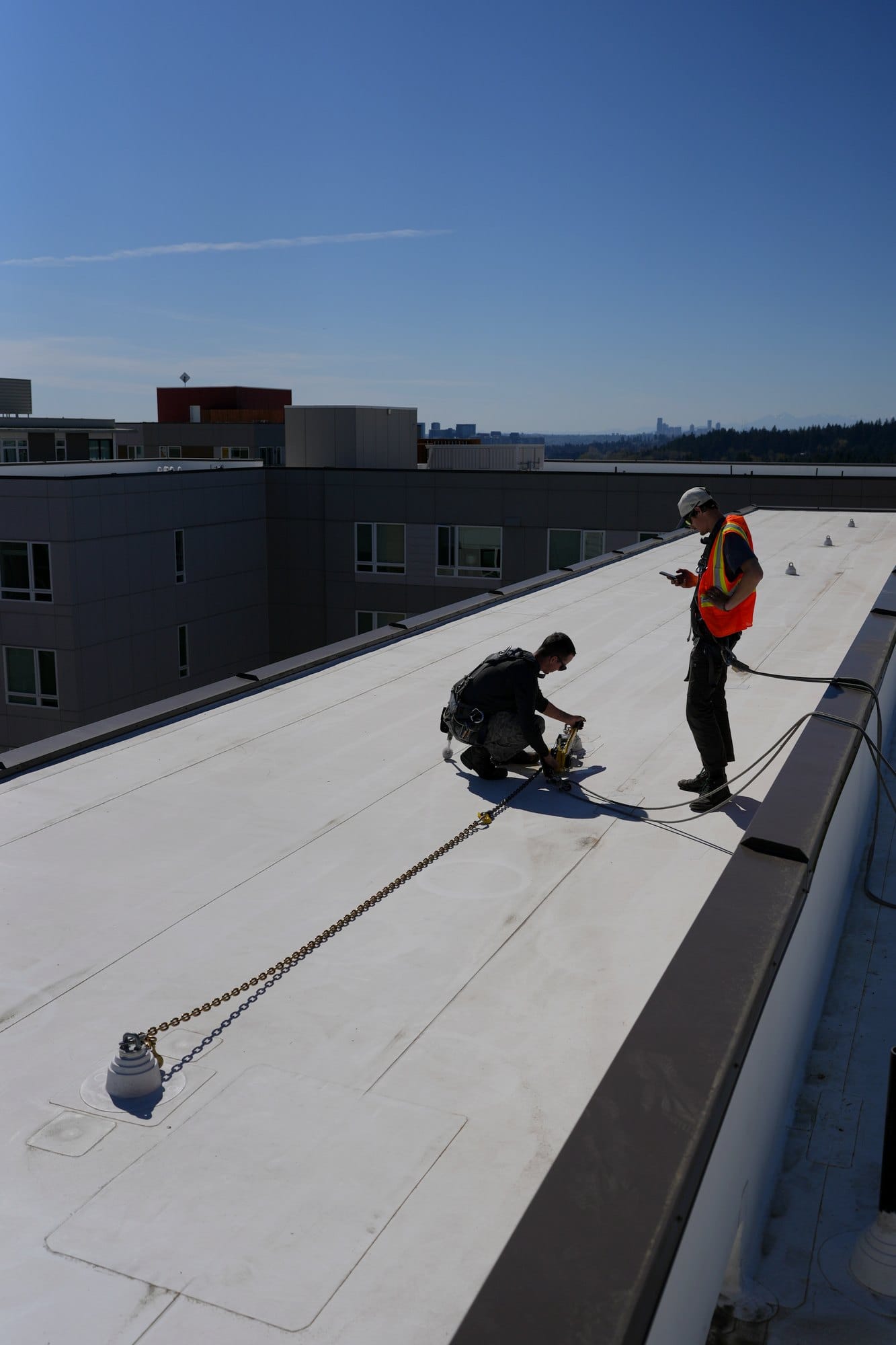
What Load Testing Proves That Eyes Cannot
A visual inspection can tell you an anchor looks sound. It cannot tell you what is happening below the base plate, inside the embedment, or within a substrate that has spent a decade in desert conditions. Load testing closes that gap: a calibrated hydraulic rig applies a controlled, measured pull to the anchor in the direction it would be loaded in service, and the anchor either holds or it does not. The result is a number on an instrument and a documented hold time, not an opinion.
Las Vegas gives hidden deficiencies unusual room to develop. Ultraviolet exposure degrades the sealants around anchor penetrations, monsoon rains then find the opening, and moisture reaches embedments that stay invisible from the surface. Daily thermal cycling, scorching afternoons followed by cool desert nights, works fasteners and connections loose over years. An anchor can pass a visual check with all of this underway. Testing is how the certification behind it stays honest.
Anchors are load tested to the levels specified by the anchor manufacturer and applicable standards, with documented hold times. Each test is instrumented, recorded, and tied to the anchor's ID on the labeled roof plan.
Where Testing Fits in the Certification Chain
Testing exists to support certification. OSHA 29 CFR 1910.27(b)(1) requires building owners to identify, test, certify, and maintain each rope descent anchorage so it is capable of supporting at least 5,000 pounds per attached worker, with written certification, annual inspection, and recertification at least every 10 years. Nevada applies that rule through NAC 618 under its own OSHA-approved state plan. The test record is a core piece of the evidence a licensed structural engineer relies on before signing the certification.
In Las Vegas, testing typically enters the picture in four situations:
- The 10-year recertification cycle. Every rope descent anchorage is tested as part of roof anchor recertification, with every result reviewed by the licensed structural engineer.
- Missing records. Mid-2010s buildings that changed owners or managers often have no installation documentation. Testing is how a system with no paper trail becomes certifiable.
- After repair or modification. Re-roofing, structural work, or anchor repairs mean the affected anchorages get re-verified before returning to service.
- After a known impact. Monsoon microbursts and wind-driven debris can load rooftop hardware in ways it was never meant to see. Post-storm verification protects both the workers and the certification.
Restraint, Arrest, and Rope Descent: Testing Follows the System
Not every anchor on a Las Vegas roof should be tested the same way, and some should not be pull-tested at all. Fall restraint anchors are designed to keep a worker from reaching the edge in the first place. The 1,000 pound figure associated with restraint hardware is a design capacity, not a field test target, and restraint anchors are evaluated through visual inspection and substrate review rather than hydraulic testing.
Rope descent anchorages, the tie backs suspended window cleaning depends on, are where testing carries legal weight, because the owner's written certification under 1910.27(b)(1) has to rest on evidence. Fall arrest anchors sit in between: 1910.140 sets no fixed federal test cycle, so the manufacturer's instructions and the judgment of the licensed structural engineer determine what gets tested and when.
That is why our testing scope is never a flat percentage. It is set per building, by system type, anchor population, substrate, age, and the condition found during inspection.
Testing Without Disrupting a 24/7 Property
Hydraulic testing is quiet, roof-level work. On hospitality and gaming properties it is scheduled into the building's no-downtime windows, usually early morning, which in summer also keeps technicians and instruments out of peak rooftop heat. Guest floors, gaming floors, and public spaces are never involved.
ADS Contractors serves building owners across the Las Vegas valley, from resort-corridor towers to Summerlin and Henderson mid-rises, and coordinates testing with the annual inspection visit wherever possible so the roof is opened once, not twice. The broader rule set is covered in our roof anchor compliance guide, statewide coverage is on the Nevada page, and the certification service this testing supports is described under roof anchor recertification.
Las Vegas Roof Anchor Load Testing FAQ
Does each anchor on the roof get load tested?
Yes. ADS load tests every anchor in the system as standard practice, and each anchor gets its own documented result tied to the labeled roof plan. Sampling programs are available on request for large portfolios, but sampling is never the default.
What load do you test to?
Anchors are load tested to the levels specified by the anchor manufacturer and applicable standards, with documented hold times. The instrument record for each test is tied to the anchor's ID on the labeled roof plan and becomes part of the certification file.
Can load testing damage my roof or my anchors?
A test is a controlled, instrumented pull, and an anchor that passes is unharmed. An anchor that fails was already unsafe; finding that on a planned test day, rather than under a suspended worker, is the entire point. Deck surfaces around the test location are protected during the work.
Do fall restraint anchors get load tested?
No. Fall restraint anchors are designed to keep workers away from the edge, and the 1,000 pound figure associated with them is a design capacity rather than a test target. They are evaluated through visual inspection and substrate review.
Our Las Vegas Anchor Services
Annual Anchor Inspection
Yearly documented anchor checks with photos, built for desert wear patterns.
10-Year Recertification
Engineering recertification for rope descent anchorages reaching the federal deadline.
Tie Back Recertification
Written certification for the tie backs that suspended facade work depends on.
Hydraulic Load Testing
Anchor capacity verified to manufacturer and standard specified levels, hold times documented.
Davit Arm Inspection
Arm and base socket inspection for suspended access systems on high-rise towers.
All Las Vegas Services
Back to the Las Vegas hub for an overview of everything ADS brings to the market.
Ready to Get Started?
Contact ADS Contractors for a no-obligation review of your building's anchor documentation. Call the Las Vegas line at (725) 255-9967 or reach us through the contact page and we will take it from there.
Contact Us Today