

What a Load Test Actually Proves
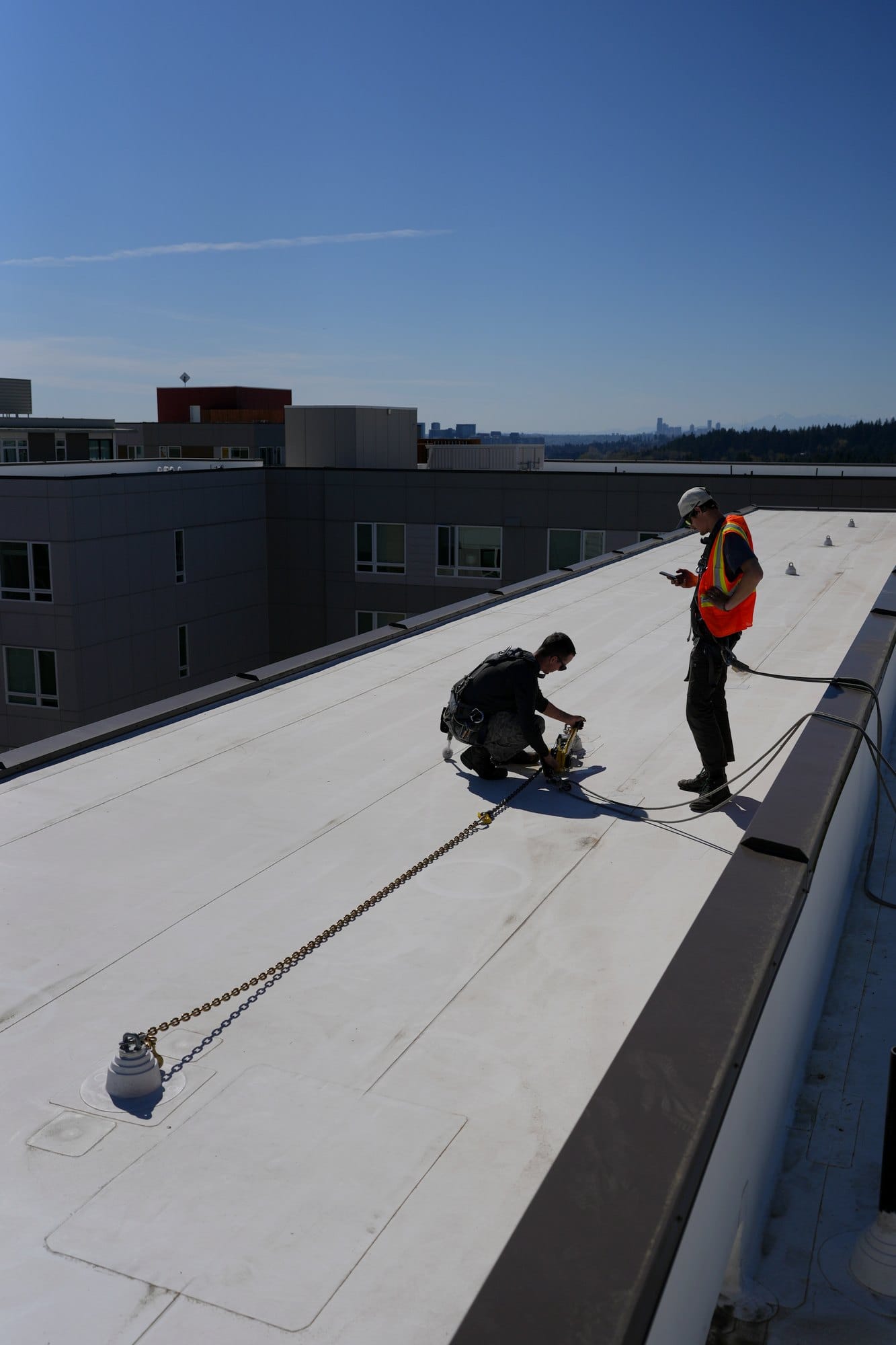
Load testing puts a controlled, measured pull on an anchor with a calibrated hydraulic rig and records how the anchor behaves. Each tested anchor is load tested to the levels specified by the anchor manufacturer and applicable standards, with documented hold times, and the result is a clean pass or fail entry in your building's certification file. No estimating, no assuming the original installation matched the drawings.
Testing matters most where the stakes are highest: anchorages used for rope descent systems. OSHA 29 CFR 1910.27(b)(1) makes the building owner responsible for identifying, testing, certifying, and maintaining each rope descent anchorage so it is capable of supporting at least 5,000 pounds per attached worker, with written certification behind it. Testing is the evidence that certification rests on. In Arizona that federal rule applies through the state's own program, ADOSH, which adopts the federal standards.
A load test is a component of certification, not a substitute for it. The test data feeds the 10 year recertification and the engineering review behind our national recertification service.
When Phoenix Anchors Get Tested
- At certification and recertification. Testing supplies the physical evidence for the initial certification of a new system and for the 10 year cycle on rope descent anchorages.
- When the paperwork is gone. Many Phoenix buildings from the 2014 to 2017 construction wave have changed owners or managers, and the original anchor documentation went missing along the way. Testing rebuilds the record from physical evidence instead of guesswork.
- After repairs or modification. A reinstalled or repaired anchor, or one affected by reroofing work, needs verification before anyone trusts it again.
- After a suspected overload. A fall event, a snagged rigging line, or storm driven impact are all reasons to test before the next use, not after.
If you are unsure which trigger applies to your building, the roof anchor compliance guide maps the requirements, and a records review is a free first step.
Why the Desert Makes Testing Worth It
Phoenix is a deceptive environment for anchors. The dry air slows the sheet rust you would see in a coastal city, so hardware often photographs well. The damage here happens where you cannot see it: sealant embrittled by years of 110 degree summers lets monsoon rain reach the fasteners below the base plate, thermal cycling gradually relaxes bolted connections, and UV bakes the protective coatings off exactly the components that clamp the anchor to the structure.
That is the specific failure mode a load test exists to catch: the anchor that looks fine and holds nothing. Our write up on desert heat and roof anchor damage covers what a decade of Sonoran exposure does to each component. A visual inspection sees the surface. The test rig interrogates the connection to the structure itself.
This is also why Phoenix owners should be wary of paper only recertifications. A stamped letter means little if nothing was ever pulled on. When testing calendars are built for buildings in downtown and midtown Phoenix, along the Camelback corridor, or across the Tempe and Scottsdale mid rise stock, the physical test is the part that protects the owner, because the owner holds the liability if an anchorage fails in service. See our Arizona page for the statewide picture.
How ADS Tests, and How Many Anchors
ADS Contractors serves building owners and property managers in Phoenix with a testing protocol built around documentation:
- A calibrated hydraulic test rig applies the load specified by the anchor manufacturer and the applicable standards, with hold times recorded for each pull.
- Every anchor in the system is tested as standard practice, following the applicable standards and the direction of the reviewing licensed structural engineer, so the certification rests on a complete record rather than a guess.
- Any anchor that fails is tagged do not use on the spot, photographed, and written up with a repair or replacement path.
- Results are recorded per anchor on a numbered roof plan and delivered as part of the certification package, alongside davit inspection findings where a building has suspended access equipment.
Testing is disruptive if it is improvised and invisible if it is planned. We coordinate roof access, protect the membrane at every reaction point, and verify sealant condition after the rig comes off, which matters on sun brittled Phoenix roofs. The full anchor service lineup is on the Phoenix hub.
Phoenix Roof Anchor Load Testing FAQ
What load do you test to?
Test loads follow the anchor manufacturer's specification and the applicable standards, with documented hold times for each pull. The separate 5,000 pound figure owners hear about is the capacity each rope descent anchorage must be certified to support per attached worker under 1910.27(b)(1); the field test protocol is what demonstrates the system justifies that certification.
How many of my anchors get pulled?
All of them. ADS load tests every anchor in the system as standard practice, so the certification rests on a complete record rather than a token pull on the easiest anchor to reach. Sampling programs are available on request for large portfolios, but sampling is never the default.
Can load testing damage my roof?
Done carelessly on a heat aged Phoenix membrane, yes, which is why the rig's reaction points are protected, loads are applied in a controlled ramp, and every test location is checked afterward, including the sealant at the anchor base. Membrane protection is part of the written procedure, not an afterthought.
Is a load test the same as recertification?
No. The load test is the physical evidence. Recertification adds the records review, the full inspection, and review by a licensed structural engineer who stamps the certification letter. Most Phoenix owners buy them together so the roof is only mobilized once.
Our Phoenix Anchor Services
Annual Anchor Inspection
Yearly competent person inspection with photos and a signed report.
10-Year Recertification
Stamped engineering review for rope descent anchorages reaching the federal deadline.
Tie Back Recertification
Certification of rope descent and suspended access tie backs.
Anchor Load Testing
Documented load verification to manufacturer and OSHA standards.
Davit Inspection
Arm and base inspection for suspended access systems.
All Phoenix Services
Return to the Phoenix service hub for an overview of every offering.
Ready to Get Started?
Contact ADS Contractors today for a free evaluation. We will review your anchor documentation, recommend a defensible test scope, and quote the work with no obligation.
Contact Us TodayOr call our Phoenix line: (623) 552-6088