

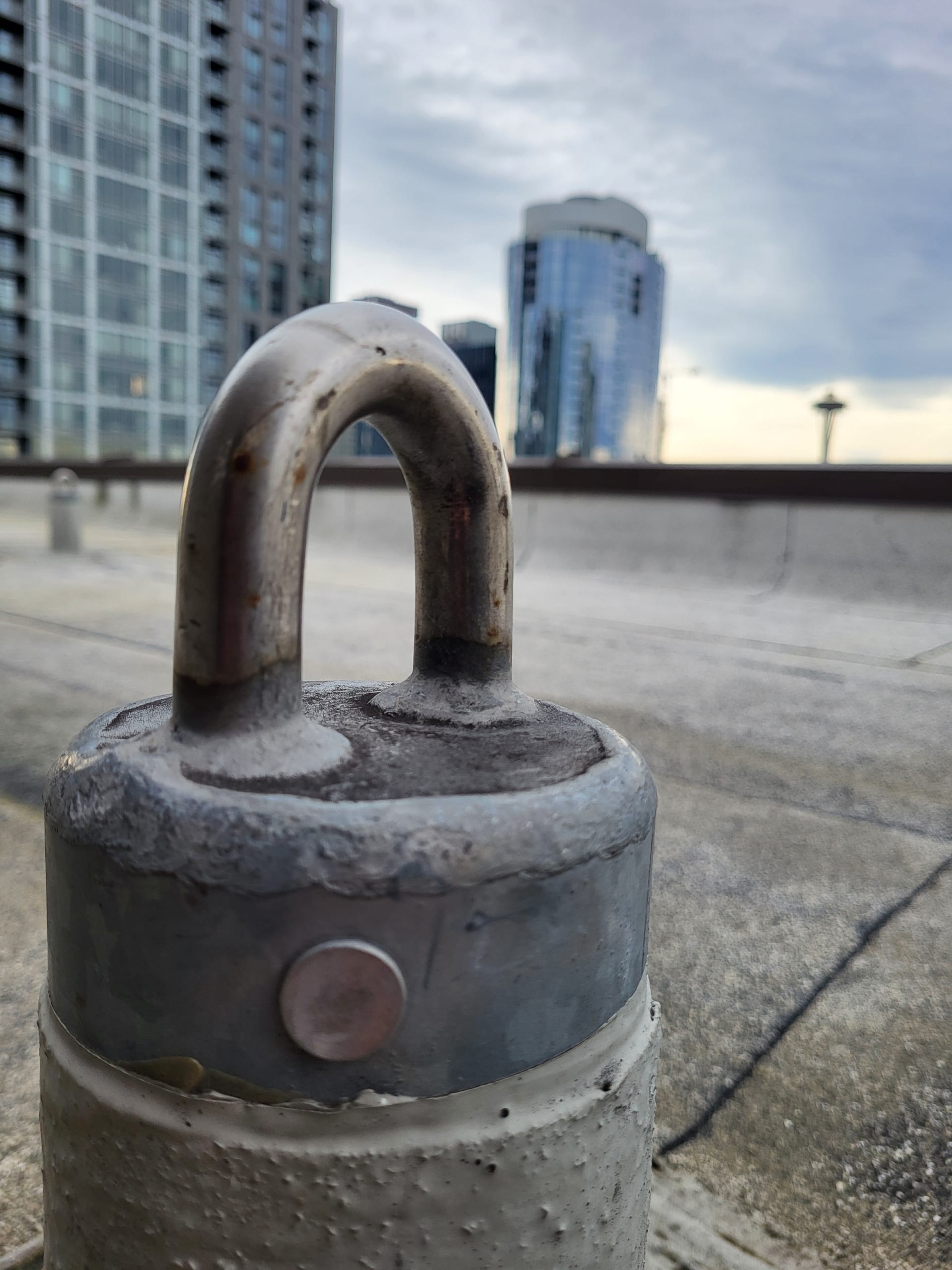
What Tie Backs Are, and Whose Problem They Are
Tie backs are the anchorages that rope descent rigging and lifelines secure to when technicians go over the side of a building: window washing descents, facade sealant work, glass replacement, inspection drops. On a Phoenix tower they are easy to forget because nobody who works for the building touches them day to day. The people who do touch them, rope access technicians, are the most safety regulated visitors your roof ever hosts.
That is exactly how the law frames it. The anchorages belong to the building, so the duties belong to the building owner, not to the vendor hanging from them. Property managers run the schedule, but the certification file, and the exposure when it is missing, sit with ownership.
Tie back recertification is the process that keeps that file alive: field verification, testing, engineering review, and a written certification that current vendors and future buyers can rely on. It complements the annual anchor inspection, which checks condition between certification cycles.
The Rule Behind It: OSHA 29 CFR 1910.27(b)(1)
Since OSHA's 2016 walking working surfaces update, the requirement has been explicit. Under OSHA 29 CFR 1910.27(b)(1), building owners must identify, test, certify, and maintain each rope descent anchorage so it is capable of supporting at least 5,000 pounds per attached worker. The certification must be in writing, the anchorages must be inspected annually, and recertification is required at least every 10 years.
Arizona owners sometimes ask whether this is a federal issue or a state one. It is both, by design. Arizona runs its own federally approved safety program, the ADOSH State Plan, which adopts the federal standards including 1910.27(b)(1). The U.S. Department of Labor affirmed the Arizona plan in 2023 after the state aligned its penalties with federal levels, so the rule reads the same in Phoenix as it does anywhere in the country.
The full regulatory picture, including how tie backs relate to fall arrest anchors and davit systems, is laid out in our roof anchor compliance guide.
The First Person to Check Your Paperwork Is Your Window Washer
In practice, the certification question rarely arrives as a letter from a regulator. It arrives as a scheduling email. Reputable rope descent contractors ask for the owner's written anchorage certification before mobilizing, because their technicians cannot legally tie off to your roof until you provide it. No certification means the drop does not happen: the job stalls, the building's glass stays dirty through tenant walkthroughs, and the owner is suddenly sourcing a recertification on a vendor's timeline instead of their own.
Phoenix adds a twist: the local market is thick with window cleaning companies and thin on dedicated anchorage certification specialists, so owners often discover there is a queue precisely when they can least afford one. Getting the certification file current before it is requested is the cheap version of this problem.
A decade of desert exposure raises the stakes on the physical side too. Heat embrittled sealant, UV thinned coatings, and monsoon grit and moisture all concentrate their damage at the anchorage base, the exact zone recertification scrutinizes. Our post on desert heat and roof anchor damage details what ten Phoenix summers do to tie back hardware.
Phoenix Timing and the ADS Process
Phoenix built aggressively between 2014 and 2017: towers downtown and in midtown, projects along the Camelback corridor, mid rises across Tempe and Scottsdale. Tie backs certified when those buildings were commissioned are entering their 10 year recertification window as a cohort, which is why this service is suddenly on so many Phoenix owners' desks at once.
ADS Contractors serves building owners and property managers in Phoenix with the process behind our national recertification service: identify and map each rope descent anchorage on a numbered roof plan, inspect every component, load test to the levels specified by the anchor manufacturer and applicable standards with documented hold times, and route the field data to a licensed structural engineer whose stamp backs the written recertification.
The deliverable is a certification package you can forward to any vendor the day they ask. Where the building also has davit equipment, the davit inspection folds into the same mobilization. The rest of the lineup lives on the Phoenix hub and the Arizona page.
Phoenix Tie Back Recertification FAQ
Is tie back recertification legally required in Phoenix?
Yes, for anchorages used with rope descent systems. 1910.27(b)(1) requires written certification, annual inspection, and recertification at least every 10 years, and Arizona applies that federal standard through its ADOSH program. If your building's exterior is maintained by rope, this rule is already operating on you.
Which anchors on my roof count as rope descent anchorages?
Any anchorage that suspension rigging or its lifelines secure to during rope descent work, which typically includes dedicated tie backs at the parapet and can include other rated anchor points your vendor rigs from. Part of the field survey is establishing exactly which anchors serve rope descent, because those carry the certification duties while pure fall arrest anchors follow the manufacturer's cadence under 1910.140.
We cannot find any certification records. Now what?
Treat the system as uncertified and rebuild the file. That is common on Phoenix buildings that changed ownership since the 2014 to 2017 construction wave. The recertification process, identification, inspection, testing, and engineering review, produces a fresh written certification without needing the lost originals.
What do I receive, and how fast can it happen?
A numbered roof plan, per anchorage inspection and test results with photos, and a written recertification stamped by a licensed structural engineer, delivered in a format your team can forward to vendors, insurers, or a buyer's counsel. Timeline depends on roof size and access, but owners who start before a vendor asks control the schedule instead of the queue.
Our Phoenix Anchor Services
Annual Anchor Inspection
Yearly competent person inspection with photos and a signed report.
10-Year Recertification
Stamped engineering review for rope descent anchorages reaching the federal deadline.
Tie Back Recertification
Certification of rope descent and suspended access tie backs.
Anchor Load Testing
Documented load verification to manufacturer and OSHA standards.
Davit Inspection
Arm and base inspection for suspended access systems.
All Phoenix Services
Return to the Phoenix service hub for an overview of every offering.
Ready to Get Started?
Contact ADS Contractors today for a free evaluation. We will review whatever certification records exist, confirm what your vendors will ask for, and quote the recertification with no obligation.
Contact Us TodayOr call our Phoenix line: (623) 552-6088