

Why a Visual Pass Cannot Clear a Corroded Anchor
Honolulu is the market where the difference between looking at an anchor and testing one matters most. Chloride corrosion does its worst work where nobody can see it: inside the concrete embed, under the base plate, along the shank of a fastener. An anchor can present a clean coating and tight hardware on the surface while the steel doing the actual work underneath has been losing section for years. Our post on Honolulu's salt air and anchor systems walks through how that hidden loss happens.
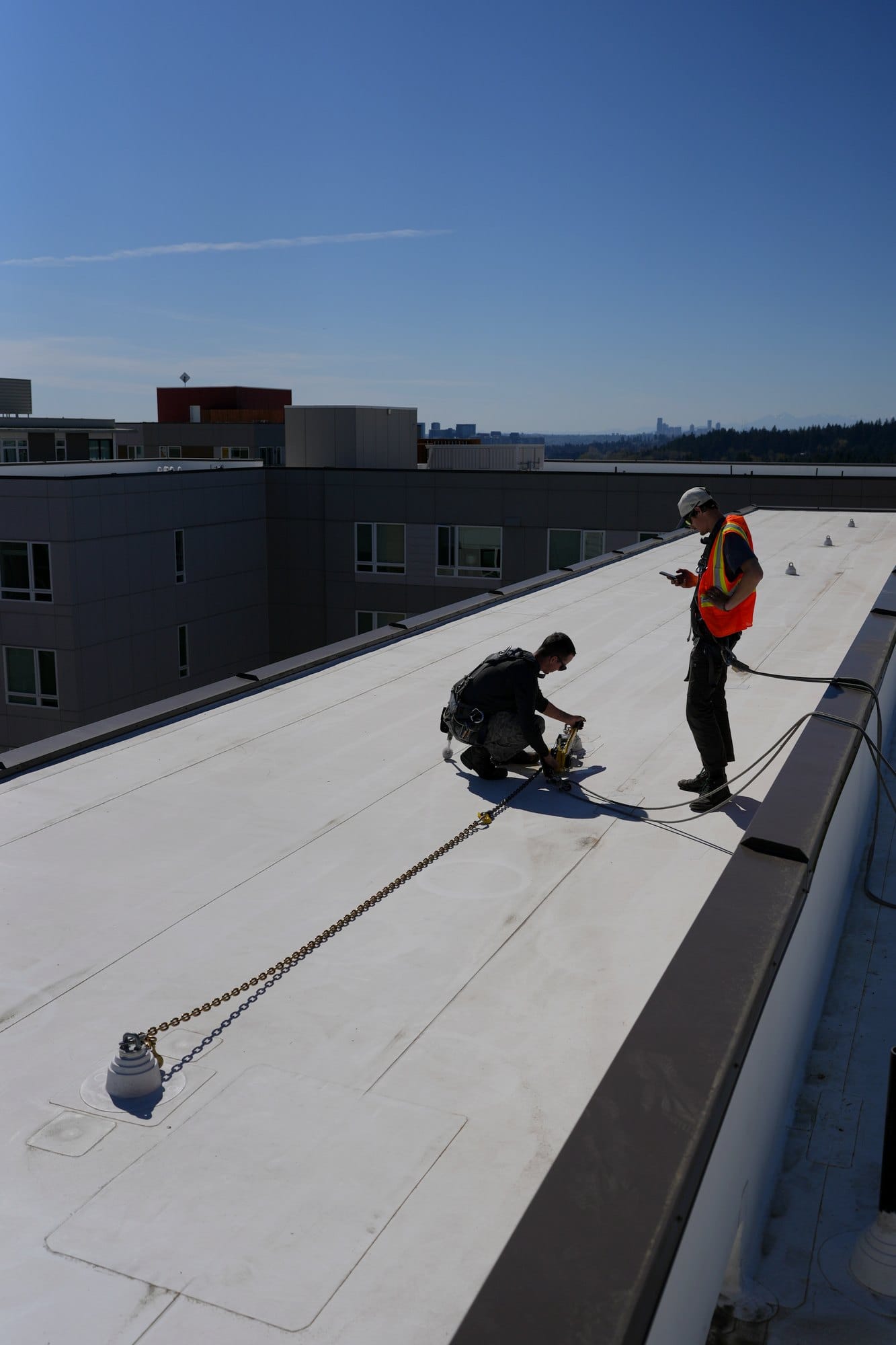
A load test removes the guesswork. A calibrated hydraulic rig applies a measured pull to the anchor in the direction it would be loaded in service, holds it for a documented time, and records whether the anchor and its substrate held. The result is binary and written down: this anchor demonstrated its required capacity on this date, or it did not and came out of service.
For the anchorages that window washing and suspended access rig into, testing is not optional background: OSHA 29 CFR 1910.27(b)(1), which Hawaii applies through its HIOSH state plan, makes the building owner responsible for anchorages that are identified, tested, certified, and maintained, each capable of supporting at least 5,000 pounds per attached worker. Testing is the step that turns that sentence from a claim into a record.
How ADS Load Tests Anchors in Honolulu
ADS uses calibrated Staht hydraulic test rigs with continuous load monitoring. Each test is set up to pull the anchor the way a worker would actually load it, and each anchor tested gets its own digital record: target load, hold time, movement observed, and a pass or fail outcome.
We keep the marketing honest on numbers. Anchors are load tested to the levels specified by the anchor manufacturer and applicable standards, with documented hold times. The right test load depends on the anchor type, the standard governing the work, and the engineer reviewing the results, so a quote for your building states the protocol before anyone rigs a ram.
When a test passes, it is non-destructive and the anchor goes straight back into service with its record updated. When a test fails, that is the system working: the anchor is tagged out of service, documented photographically, and flagged for repair or replacement, and the reviewing engineer decides whether similar anchors elsewhere on the roof should be tested as well.
When Honolulu Buildings Need Load Testing
The common triggers on Oahu:
- The 10 year recertification. Load testing every anchor in the system is the physical backbone of a roof anchor recertification, and Kakaako era towers certified in the mid 2010s are arriving at that milestone now.
- Missing records. Many 1960s through 1980s concrete towers in Waikiki, Makiki, and around Ala Moana have anchors with no surviving installation or capacity documentation. Testing is how a building with no paperwork gets a defensible baseline.
- After repair or replacement. Any anchor that has been repaired, reinstalled, or had its substrate disturbed gets tested before it carries a worker again.
- After a known event. A reroof, structural work near the anchor, a dropped davit arm, or any suspected overload calls for retesting the affected anchors.
- Corrosion findings. When an annual inspection turns up rust staining at an embed or pitting at a base plate, a test answers the question the eye cannot.
Testing is also the honest tiebreaker when a board inherits a roof full of unknowns from a prior managing agent. One field day of instrumented pulls settles arguments that could otherwise stall a window washing contract for months.
Fall Arrest, Rope Descent, and Fall Restraint: What Gets Tested
Different anchors on a Honolulu roof get different treatment, and the distinctions matter. Anchorages serving rope descent systems carry the owner certification duties described above, and ADS load tests every one of them during recertification as standard practice. Fall arrest anchors, the ones a walking worker clips a lanyard into, are tested when the manufacturer's instructions, an engineer's direction, or missing documentation calls for it.
Fall restraint anchors are the exception people get wrong. A restraint anchor exists to keep a worker back from the edge, not to catch a fall, and its published 1,000 pound figure is a design capacity, not a field test value. ADS evaluates restraint anchors through visual inspection and substrate review rather than hydraulic pulls, and any vendor who quotes you a test on them is telling you something about their reading of the standards.
ADS load tests every anchor in the system as standard practice, and the reviewing engineer, a Hawaii-licensed structural engineer independent of the sales pitch, reviews the scope and every recorded result. Sampling programs are available on request for large portfolios, but sampling is never the default. If you want the wider regulatory context first, start with our roof anchor compliance guide, or see the Honolulu service hub for the rest of the Honolulu line-up, including davit inspection for buildings with articulating arm systems. Our national roof anchor recertification page shows where testing sits in the certification path for buildings anywhere in Hawaii.
Honolulu Roof Anchor Load Testing FAQ
What load do you apply during a roof anchor test?
Anchors are load tested to the levels specified by the anchor manufacturer and the applicable standards, with documented hold times. The correct target depends on the anchor type, its use case, and the standard governing the work, so the protocol is stated in writing before testing begins and every result is recorded as pass or fail.
Will load testing damage my roof or my anchors?
A passing test is non-destructive: the load is applied in a controlled, instrumented pull and the anchor returns to service. An anchor that fails was already unsafe, and finding that on a planned test day, with the anchor immediately tagged out of service, is precisely the point of testing.
Do fall restraint anchors get load tested too?
No. Restraint anchors are designed to keep workers away from the edge rather than to arrest a fall, and their 1,000 pound rating is a design capacity rather than a field test value. They are evaluated through visual inspection and substrate review. Testing effort goes to the anchorages that carry suspended workers.
How many anchors on a Honolulu roof need testing during recertification?
All of them. ADS load tests every anchor in the system as standard practice, so each anchor gets its own documented pass or fail record. Sampling programs are available on request for large portfolios, but sampling is never the default.
Anchor Services for Honolulu Buildings
Annual Anchor Inspection
Yearly visual and structural anchor checks with photo documentation, tuned to salt air conditions.
10-Year Recertification
Stamped engineering recertification for rope descent anchorages reaching the 10 year mark.
Tie Back Recertification
Written recertification for the tie back anchors that suspended workers connect to.
Anchor Load Testing
Instrumented load testing with documented hold times and a pass or fail record for each anchor tested.
Davit Inspection
Arm, base, and socket inspection for high rise window washing davit systems.
All Honolulu Services
See the full menu of anchor and fall protection services for Honolulu buildings.
Ready to Get Started?
Contact ADS Contractors for a free evaluation of your building's rooftop anchor systems. Tell us what documentation you have, and we will scope the work and reply with a clear, flat quote and no obligation.
Contact Us TodayOr call our Honolulu line: (808) 427-1863