

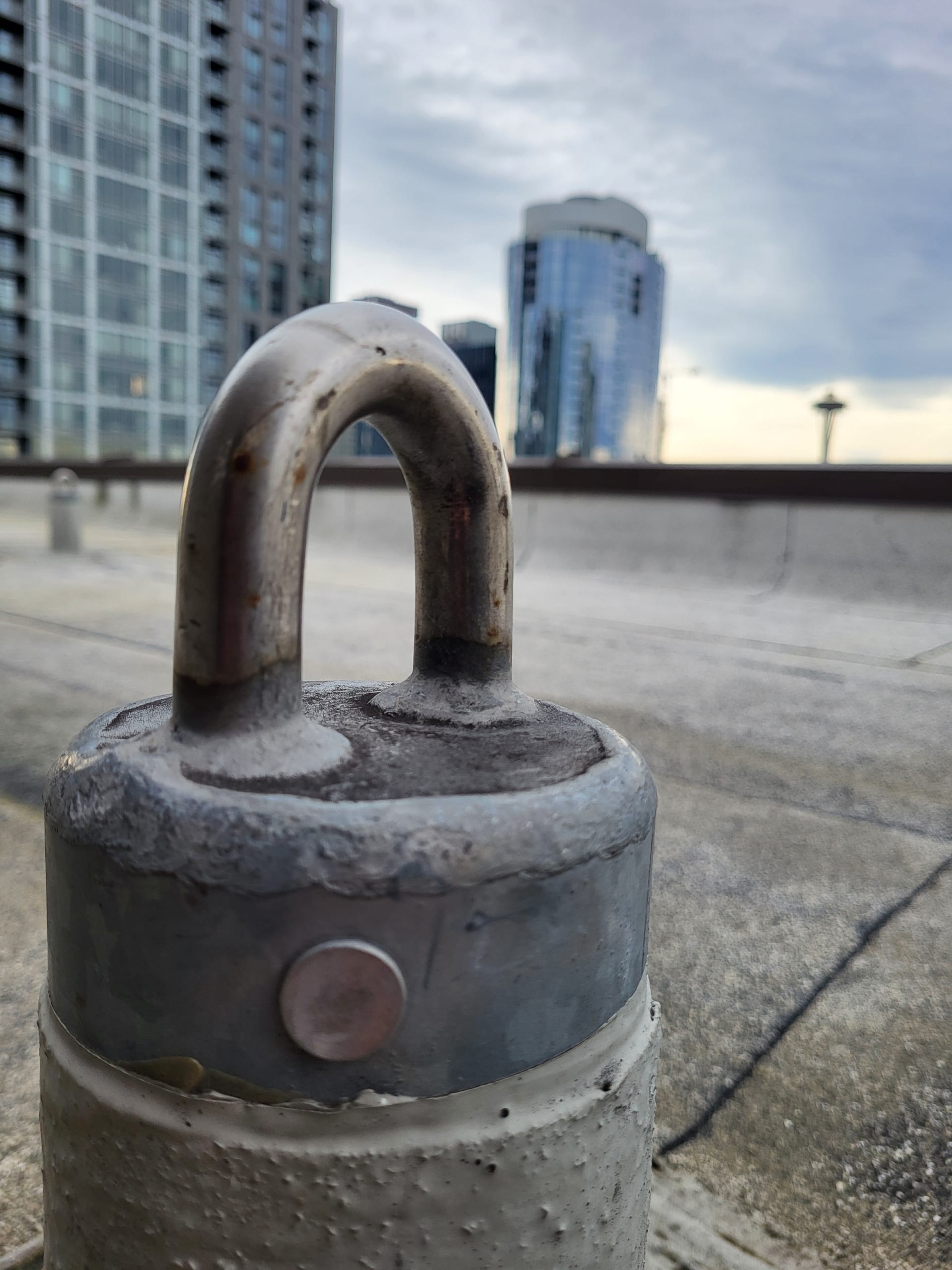
The Anchor a Suspended Worker Bets Everything On
A tie back is the rooftop anchor a suspended worker connects to before going over the parapet: the glass cleaner on a Waikiki hotel, the facade technician recaulking a Kakaako tower, the inspector photographing spalled concrete on a 1970s Makiki high rise. Whatever happens on the rope, the tie back is the thing that has to hold, sometimes for hours at a stretch, on every drop.
Tie backs are not general purpose fall arrest points. They serve rope descent and suspended access, a use case with its own federal rule and its own certification duties that sit on the building owner, not on the vendor. In Honolulu, and across Hawaii, those duties land on AOAO boards, their managing agents, and hotel facility directors.
And Honolulu tie backs age faster than their mainland twins. Salt air keeps chloride on the hardware year round, and suspended maintenance here never gets a winter pause, so the anchors see both more corrosion and more use. Our guide to salt air and Honolulu anchor inspections explains why a ten year old anchor on Oahu is not the same object as a ten year old anchor in Denver.
OSHA 29 CFR 1910.27(b)(1), as Hawaii Applies It
The rope descent system rule is blunt about whose job this is. Under OSHA 29 CFR 1910.27(b)(1), in force since 2017, the building owner must identify, test, certify, and maintain each anchorage used by a rope descent system, capable of supporting at least 5,000 pounds per attached worker, with written certification on file, inspection at least annually, and recertification at least every 10 years. There is no small building exemption and no residential exemption.
Hawaii applies that rule through its own OSHA approved state plan, HIOSH, whose standards under HAR Title 12 adopt the federal requirements. HIOSH also operates a local emphasis program on fall hazards mirroring the national falls emphasis program, which means fall protection is a stated inspection priority for the state, not an afterthought.
The practical translation for a Honolulu tower: if ropes ever come off your roof, each anchorage they connect to needs current written certification, a qualified person inspection inside the last twelve months, and a recertification dated inside the last ten years. If any of those three documents is missing, the anchorage is not compliant, whatever its physical condition.
Your Vendor Will Ask Before Anyone Ties Off
Most Honolulu boards first hear about tie back certification from their window washing vendor, because the vendor's technicians cannot legally rig to an anchorage until the owner provides the written certification the rule requires. Reputable outfits simply decline the job without it. That is not the vendor being difficult; it is the vendor declining to gamble a life on undocumented steel.
The result is a familiar Honolulu story: glass cleaning scheduled for the week before a big booking window or an owners' meeting, a document request from the vendor, a scramble through the managing agent's files, and the discovery that the certification is expired or never existed. The work slips weeks while the paperwork gets rebuilt under deadline pressure.
Boards that treat the certification file like the elevator certificate, current, filed, and boring, never live that story. Our roof anchor compliance guide lists the documents worth keeping in one folder, and the Honolulu service hub shows how the annual and ten year pieces fit together across our Honolulu services.
How ADS Recertifies Honolulu Tie Backs
Recertification is a field and engineering project, and ADS runs both halves:
- Location and inventory. Each tie back on the roof is found, numbered, and mapped, including concealed anchors behind screens and equipment that prior vendors missed.
- Condition and substrate inspection. Hardware, welds, and fasteners evaluated with Honolulu's corrosion patterns in mind, plus the concrete or steel each anchorage is embedded in.
- Load testing on every anchor. Every anchorage in the system is load tested to the levels specified by the anchor manufacturer and applicable standards, with documented hold times and recorded outcomes.
- Stamped recertification. A Hawaii-licensed structural engineer reviews the data and issues the stamped letter that resets the ten year clock for each certified anchorage.
Timing matters in this market. Kakaako era towers certified in the mid 2010s are reaching their first ten year deadline now, and the older Waikiki, Makiki, and Ala Moana concrete stock often needs its baseline built from scratch. Buildings with davit systems can fold a davit inspection into the same mobilization, and our national roof anchor recertification page covers the process in general form.
Honolulu Tie Back Recertification FAQ
What paperwork will a window washing vendor ask to see?
Written certification of each rope descent anchorage their technicians will use, a qualified person inspection dated inside the last twelve months, and a recertification dated inside the last ten years. Vendors decline to rig without these documents, so having the file current is what keeps facade work on schedule.
Is Hawaii under federal OSHA or its own program?
Hawaii runs its own OSHA approved state plan, HIOSH, administered by the state Department of Labor and Industrial Relations. Its standards adopt the governing federal rules, including OSHA 29 CFR 1910.27(b)(1) for rope descent anchorages, and the state maintains a local emphasis program focused on fall hazards.
When are Kakaako era towers due for tie back recertification?
Ten years from the date on the original written anchorage certification, which for the mid 2010s condo wave generally means deadlines landing between 2024 and 2028. Pull the certification date from the association's turnover records; if it cannot be found, treat the building as due now and rebuild the baseline.
Our tower has tie backs but no records at all. What happens?
The anchorages are treated as uncertified until proven otherwise. ADS inventories and inspects each one, load tests every anchorage to the levels specified by the manufacturer and applicable standards, and coordinates a Hawaii-licensed structural engineer's stamped certification, giving the building a clean file going forward.
Anchor Services for Honolulu Buildings
Annual Anchor Inspection
Yearly visual and structural anchor checks with photo documentation, tuned to salt air conditions.
10-Year Recertification
Stamped engineering recertification for rope descent anchorages reaching the 10 year mark.
Tie Back Recertification
Written recertification for the tie back anchors that suspended workers connect to.
Anchor Load Testing
Instrumented load testing with documented hold times and a pass or fail record for each anchor tested.
Davit Inspection
Arm, base, and socket inspection for high rise window washing davit systems.
All Honolulu Services
See the full menu of anchor and fall protection services for Honolulu buildings.
Ready to Get Started?
Contact ADS Contractors for a free evaluation of your building's rooftop anchor systems. Tell us what documentation you have, and we will scope the work and reply with a clear, flat quote and no obligation.
Contact Us TodayOr call our Honolulu line: (808) 427-1863